- Seminar 1: “Critical Themes & Research Methods” – Jon Pengelly
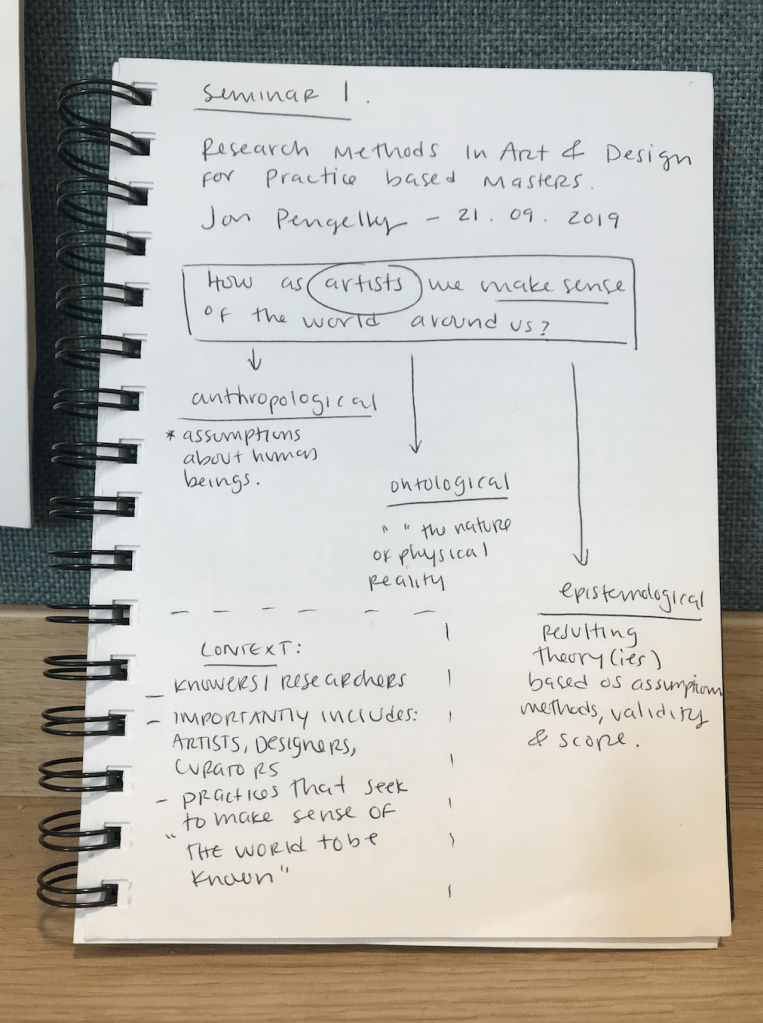
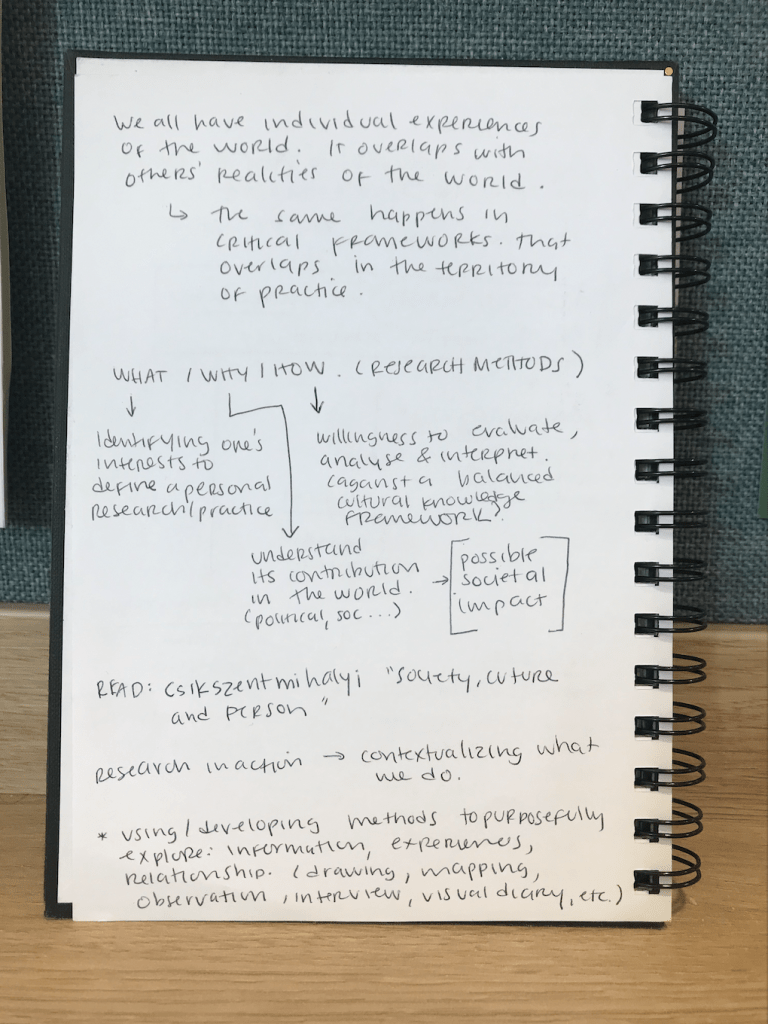
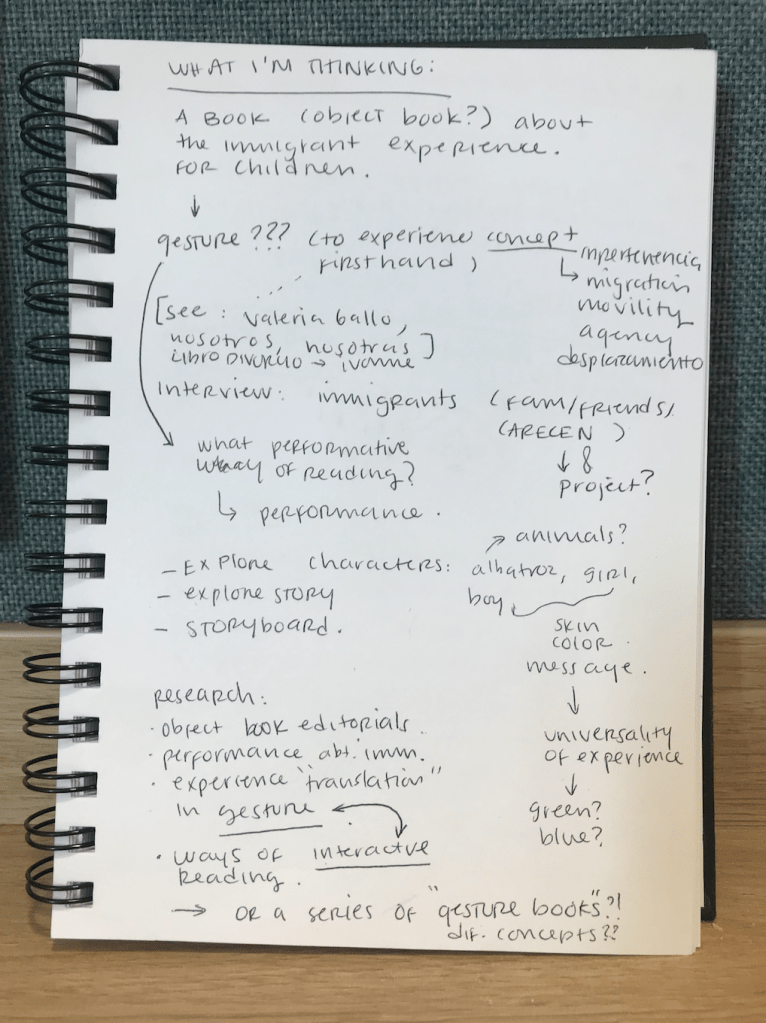
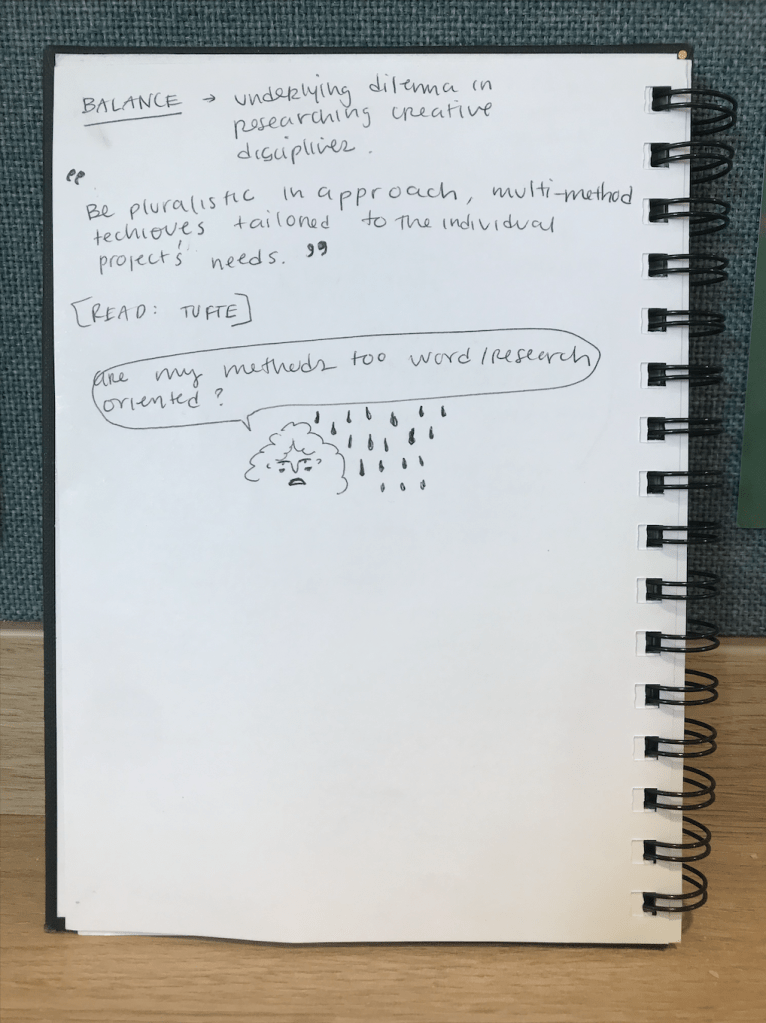
This seminar was interesting to me because it seemed like a good transition between my previous investigative journalism research methods to more visual narrative practices. I realized, by comparing each others’ methodologies, that even in my illustration work, my research methods have always been more word oriented. However, I also realized that even diverse disciplines share the same starting point, which is, most of the times, a personal interest on a specific subject. It also made we want to integrate more interviews into my project.
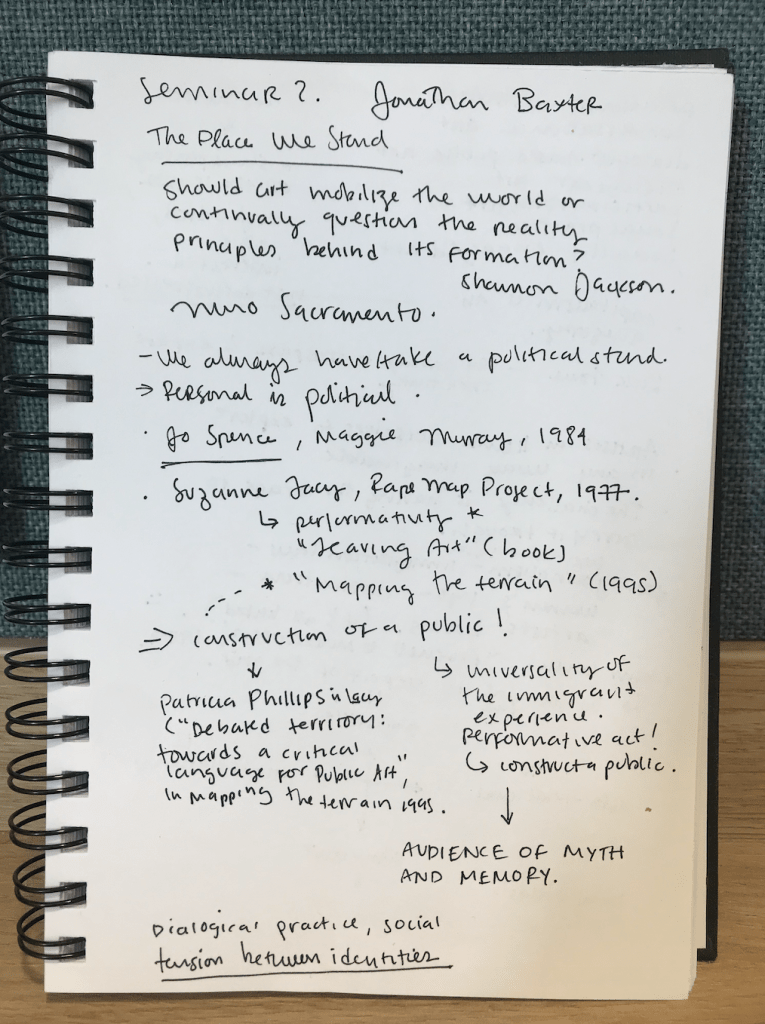
– Seminar 2: “The Place We Stand” – Jonathan Baxter
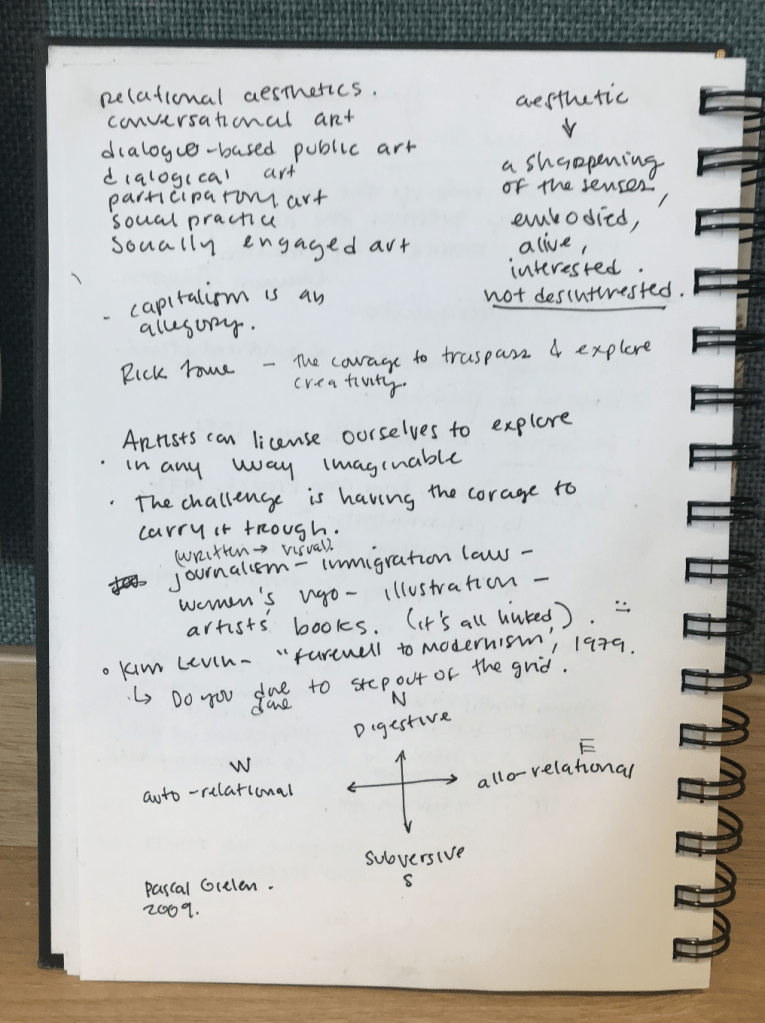
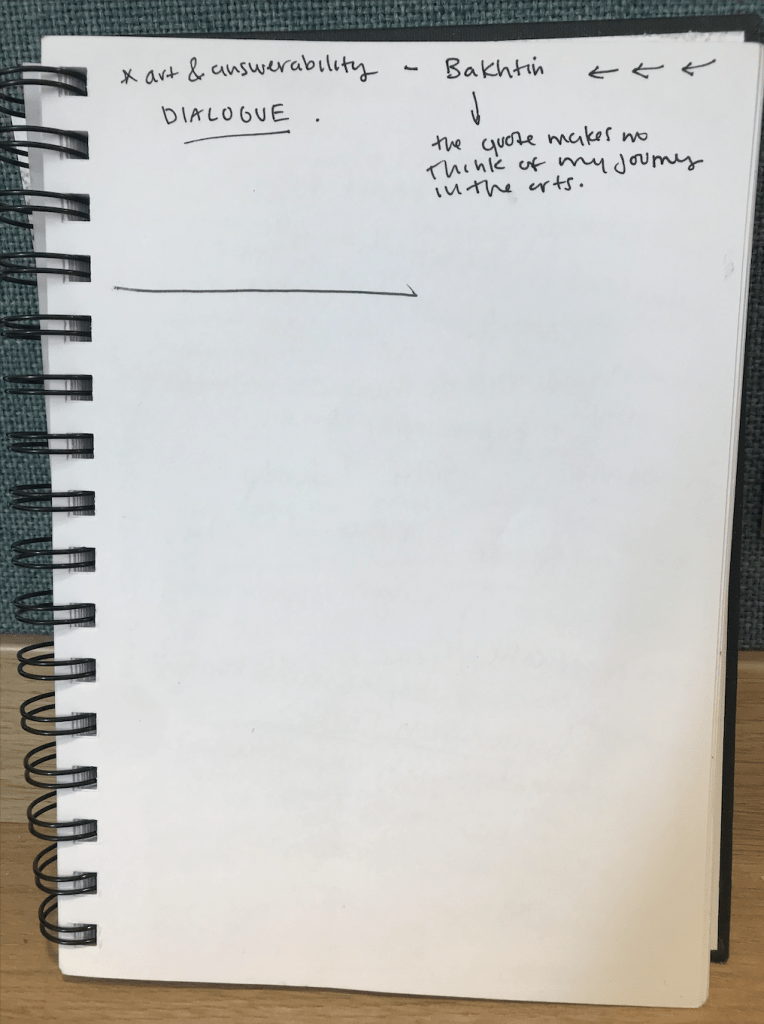
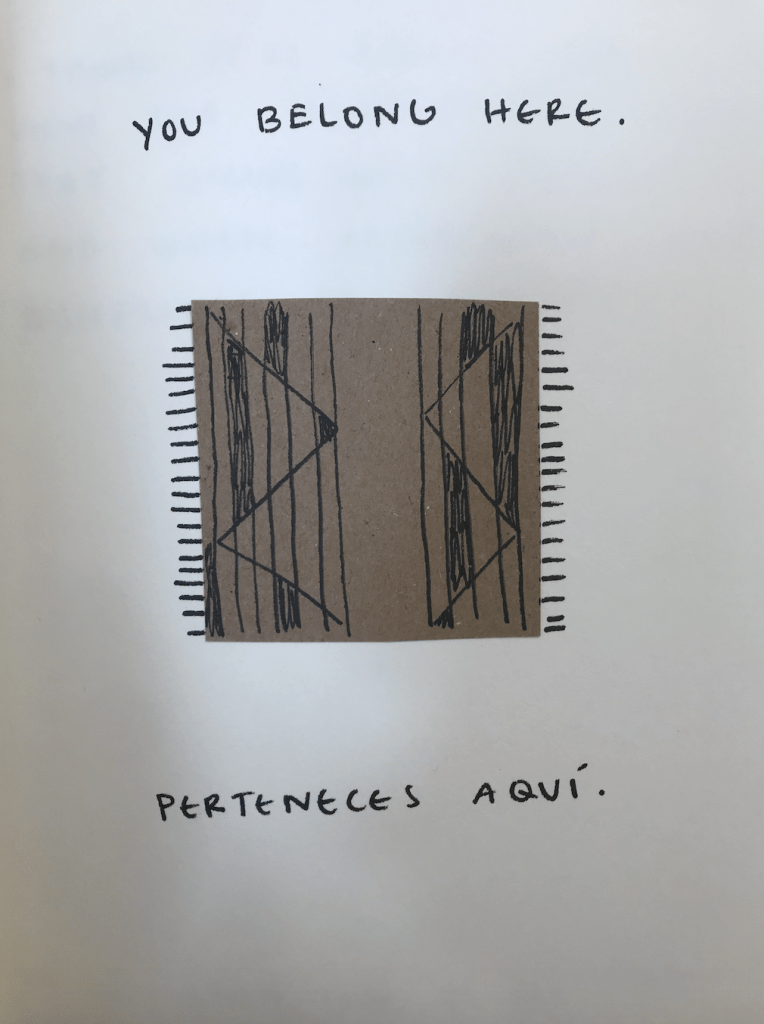
Jonathan Baxter made us stand on the place where we thought we and and our artistic practices belonged. It was a masking tape quadrant, in the allo-relational and subversive spectrum, and it made me realize how important a book about the migrant experience can be, just because it was genuinely nice to have a square of carpet where I could say I belonged.
- Research Conference: “Culture and the Periphery”
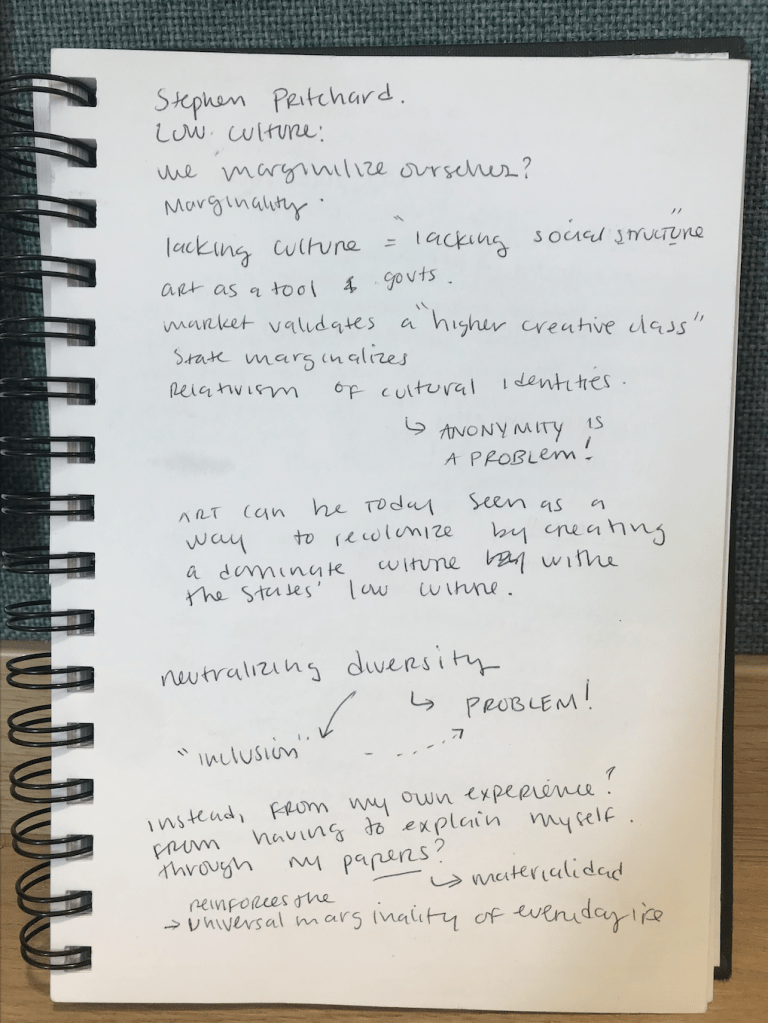
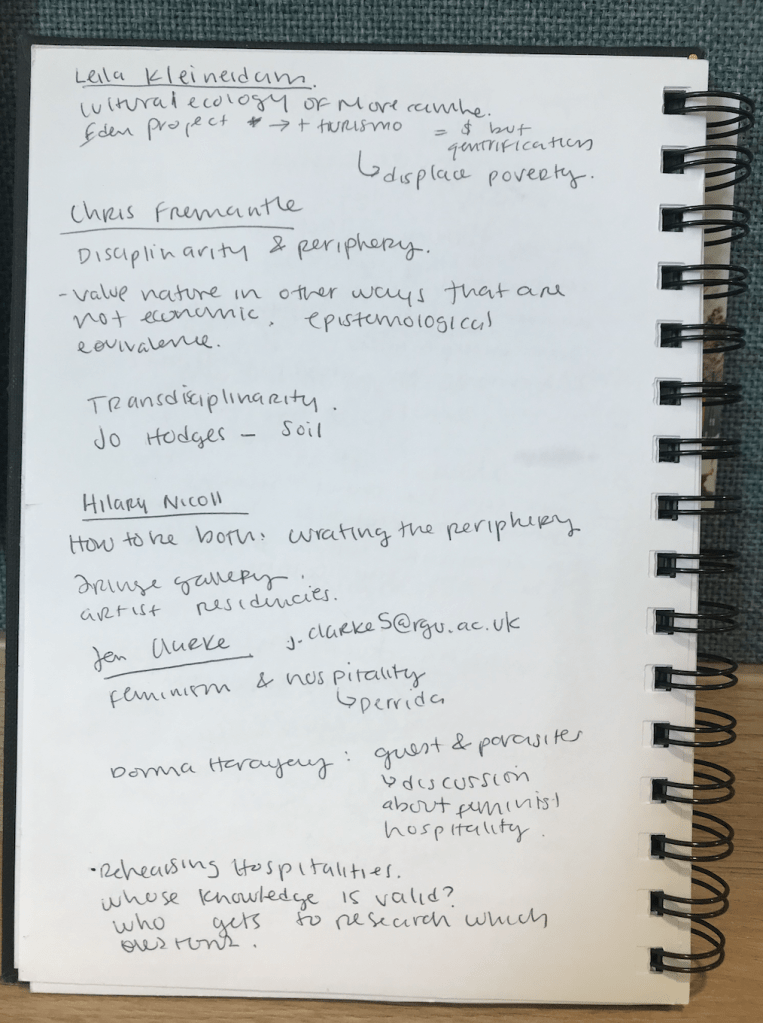
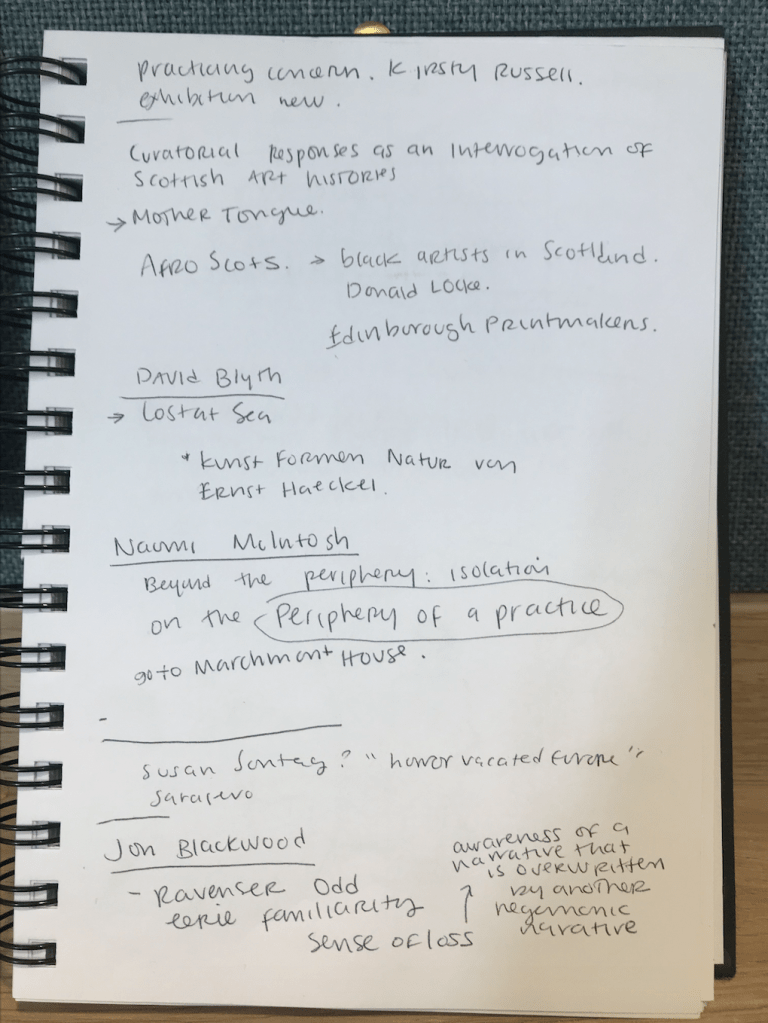
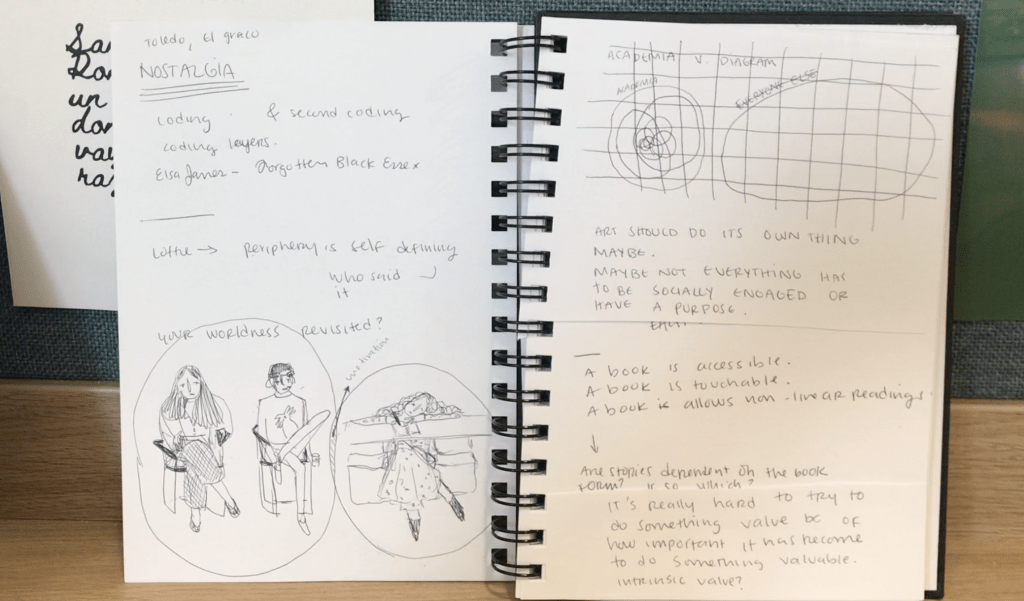
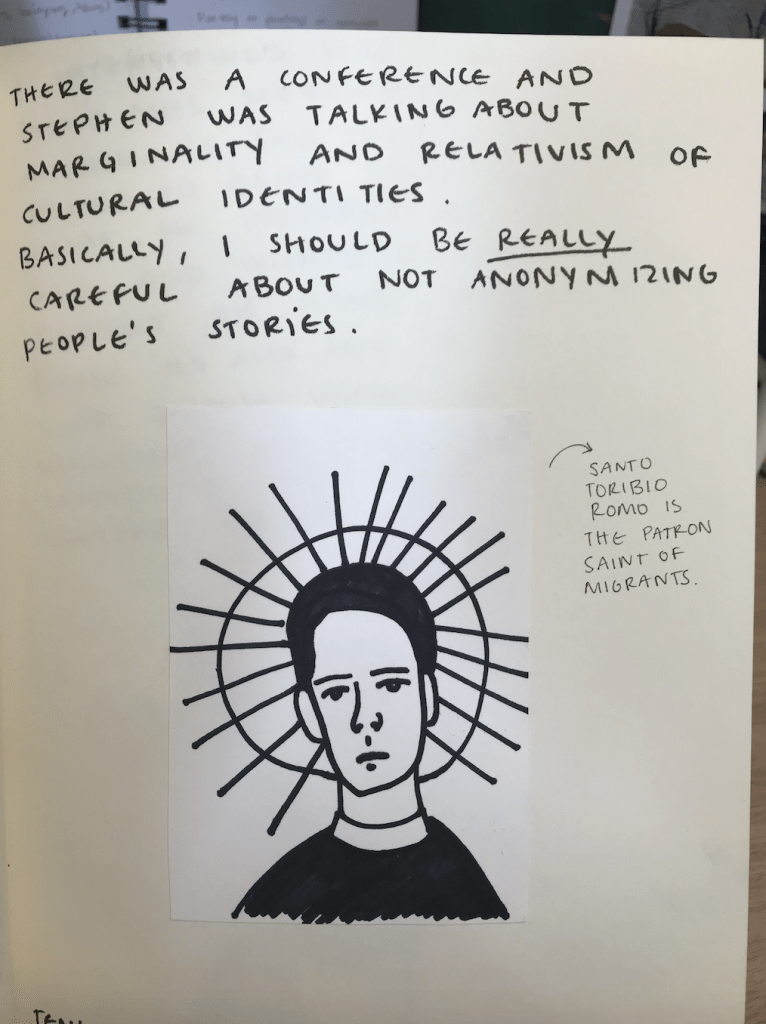
Stephen Pritchard’s conference was particularly interesting because he talked about marginality and relativism of cultural identities. It was relevant for my research because it made evident the problem of systematically anonymizing people’s stories. Going on with the interviews I conducted, I made sure to acknowledge each person and their accounts.
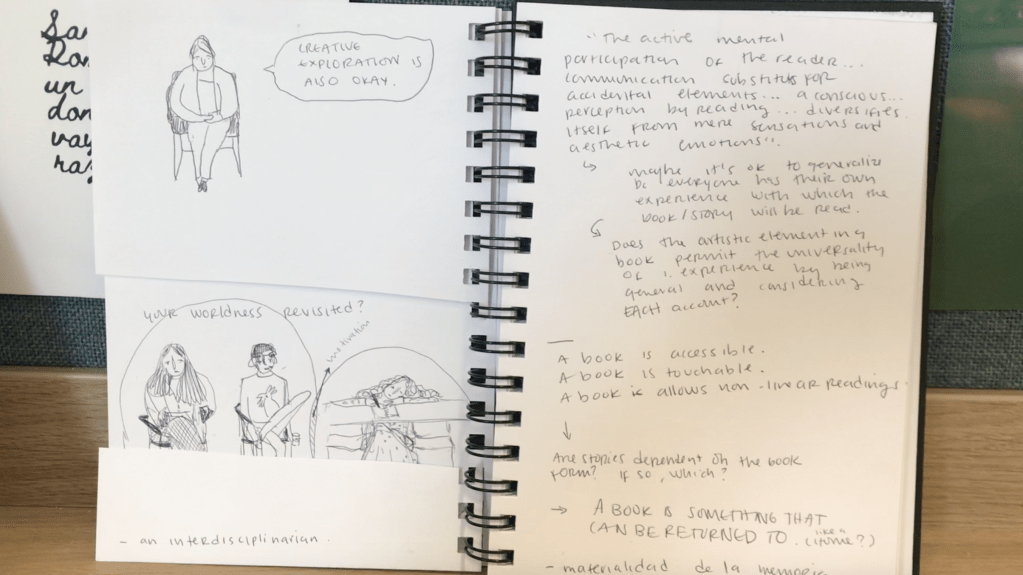
– Seminar 3: “Bodies and Monsters: Feminisms for a Post-humanist World?” – Dr. Jen Clarke
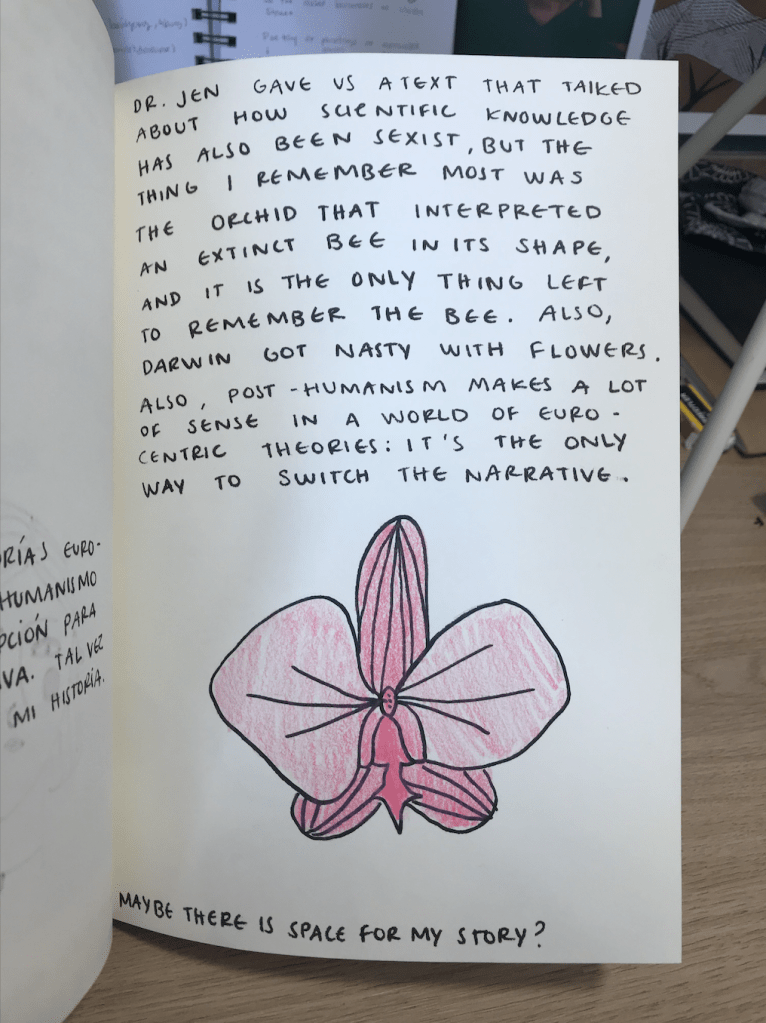
I made a video about the most interesting thing I’ve ever read, which was a chapter of a book by Anne Tsing we discussed in Dr. Jen Clarke’s seminar about feminisms in a post humanist world. The chapter includes a revision of Darwin’s Theory of Evolution and elaborates on “involution” with an orchid, as example. I made the video in Spanish, but added subtitles in English as well. I realized that talking about a type of orchid that learnt to self pollinate because the bee it mimics in its shape went extinct a long time ago, resonated with other processes relating to memory and the collective. Involution is about being able to respond as part of an interconnected whole, and it seemed relevant to the creating and sharing of narratives. This seminar was pivotal to my project because it made me realize that a space for my own experience was important.
– Seminar 4: “The Last Breakfast: What is democracy?” – Deveron Projects
Clemens Wilhelm, along with the Deveron Projects, planned the planting of a weeping willow tree to commemorate Brexit in Huntly and to acknowledge its ambivalence. However, it was interesting to see how, not only did the actual day of Brexit change, but also people’s public perception of the planting of this particular tree. I was very interested in the concept of trees communicating, not only amongst themselves, but also in the way humans have assigned symbolic meaning to different kinds. It was eventually planted in January, and not long after, cut down.
– Seminar 5: “Placemaking and Empowerment: Critical Perspectives on Socially Engaged Art & Design Practices” – Claire Abbott
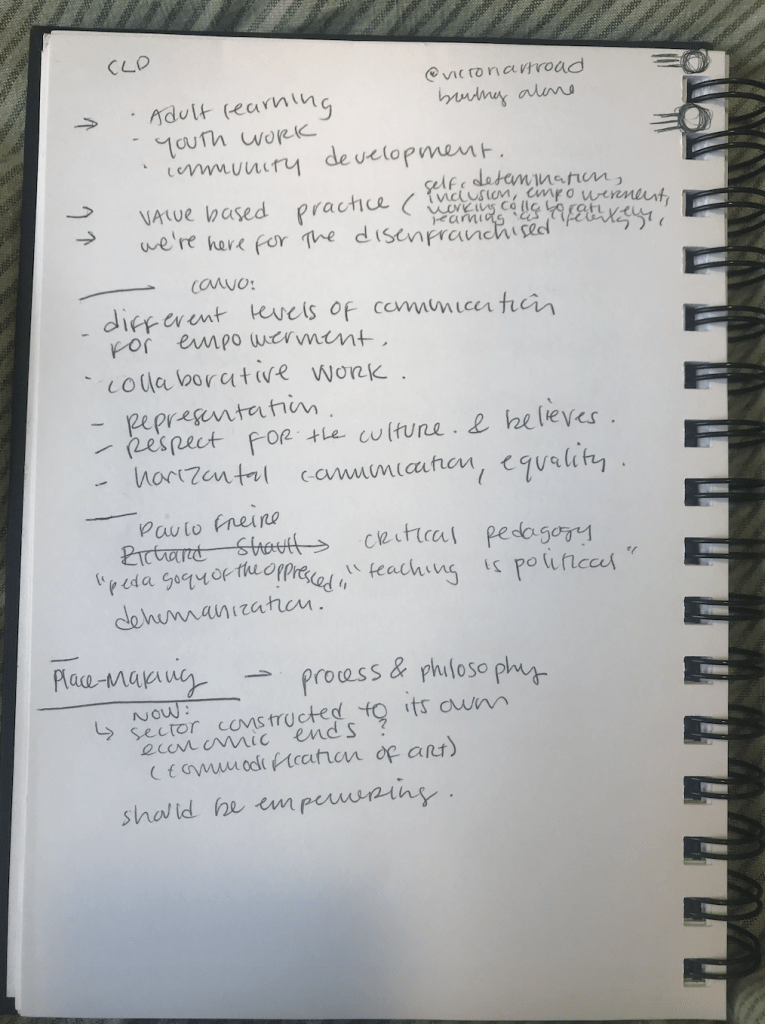
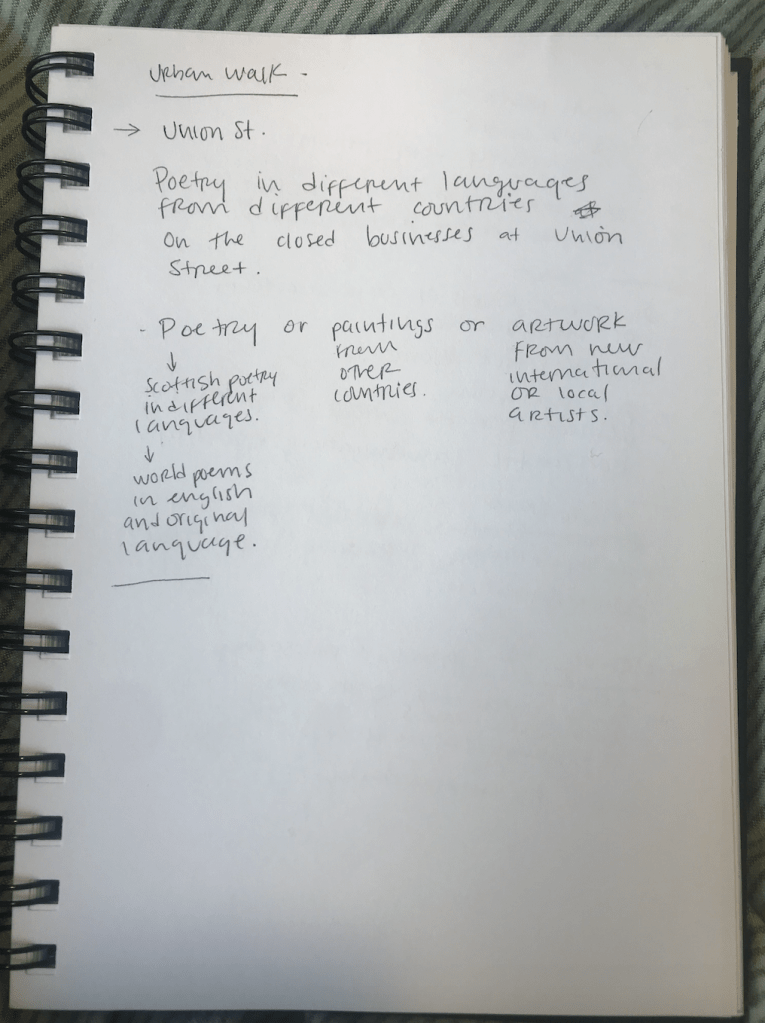
We were asked to go on an urban walk and come up with an example of socially engaged art to be set in Aberdeen. I came up with a project to make street art with poetry in different languages on the vacant businesses on Union Street. I don’t think this particular seminar connected with my project, but it made me consider more issues regarding language.
– Seminar 6: “Carbon vs Cultural Economies, representing people’s interests” – Rachel Grant
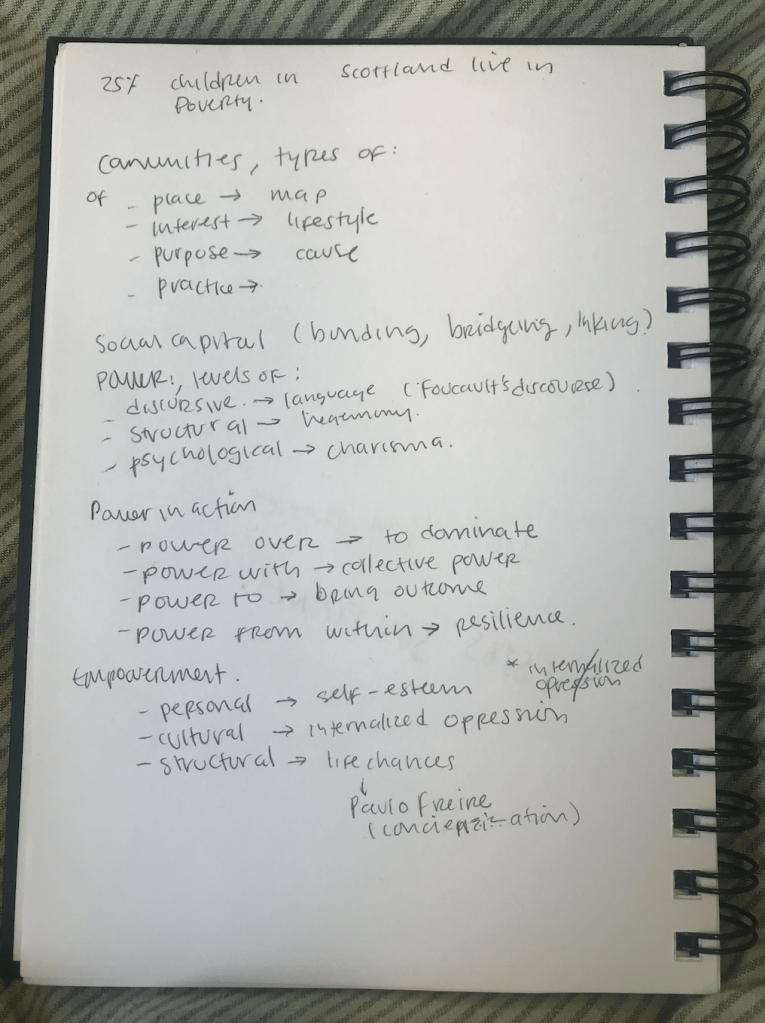
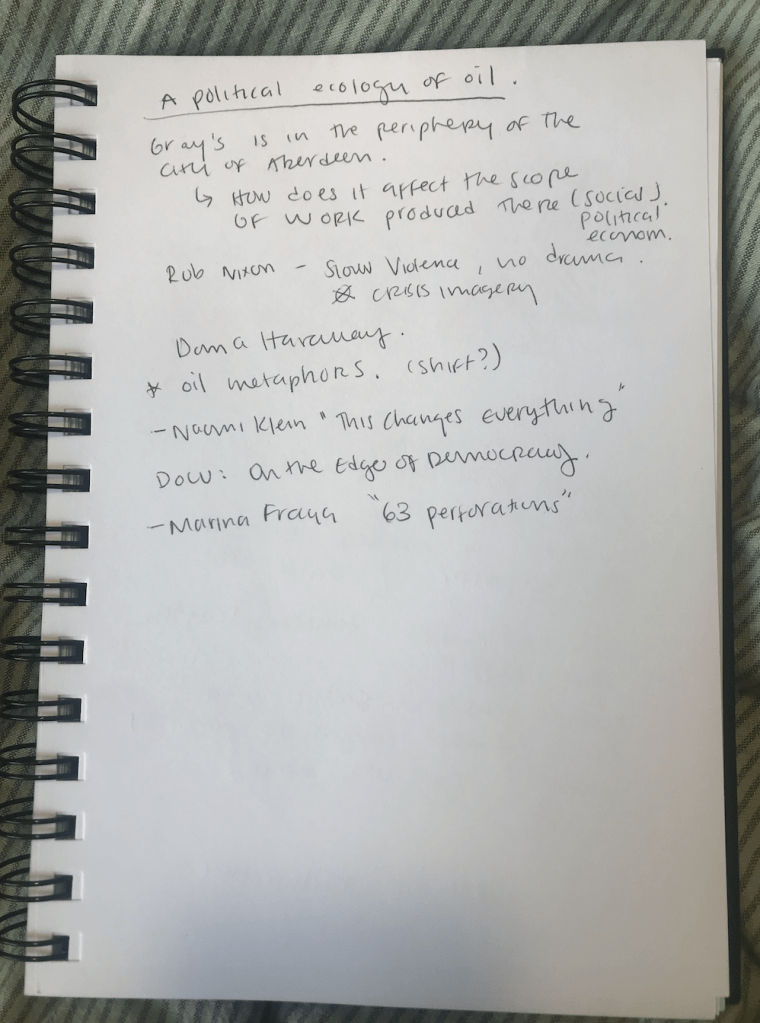
In this seminar, we talked about the political ecology of oil. It was relevant as context to understand how the oil industry, politics and human movement are interconnected. We participated in collective word association and it made this evident. I did not find a strong connection with my project but recognize it is relevant as sociopolitical context in terms of migratory issues.
– Seminar 7: “Deep Mapping” – Dr. Jon Pengelly
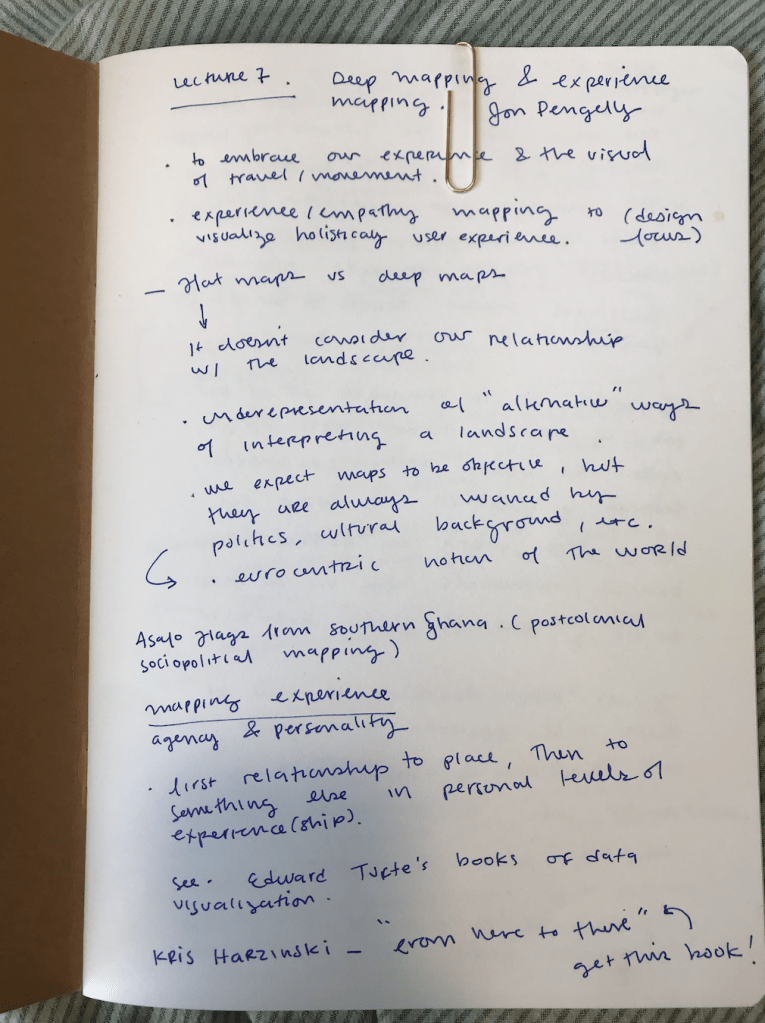
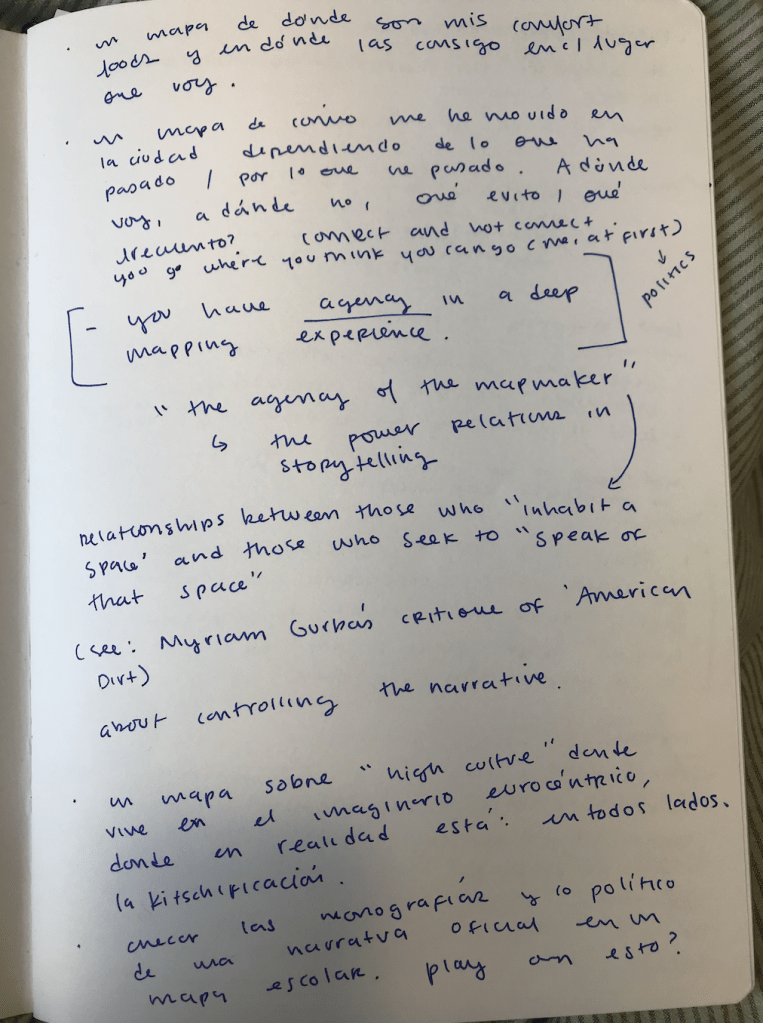
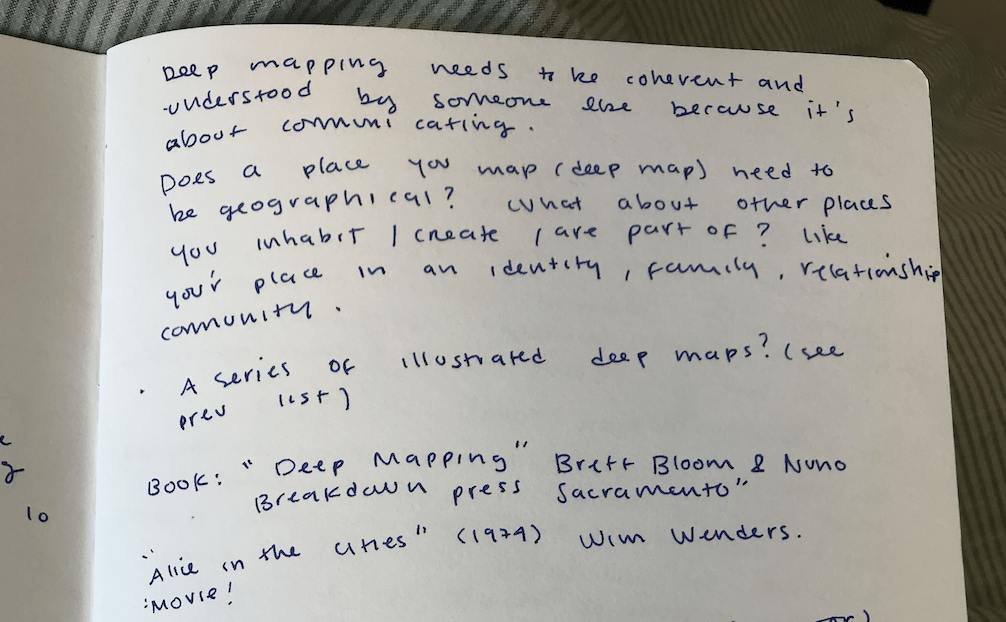
The lecture made me think that deep mapping is a just way of representing a personal account. The fact that it embraces experience as a guiding and writing tool, works well in the making of a visual representation of movement and travel. Deep mapping makes space for empathy because it makes visible the relationship between those who inhabit a space, the space itself and the people who seek to speak of that space.
It is also interesting to consider the politics of map making. A power relation exists in the narrative. It reminded me of Mexican monographs. I used to buy them in primary school from the little stationery and grocery shops that are in every corner of Mexico City. Our teachers asked us to recreate it by hand, so we would draw our interpretation of the illustrations and copy the exact text that was on the back of each. They were “official” versions of historical events such as the Mexican Independence, the Revolution, and the “discovery” of America. They were so horrible looking and, most of the time, incorrect and incomplete.
There is agency in a deep-mapping experience.
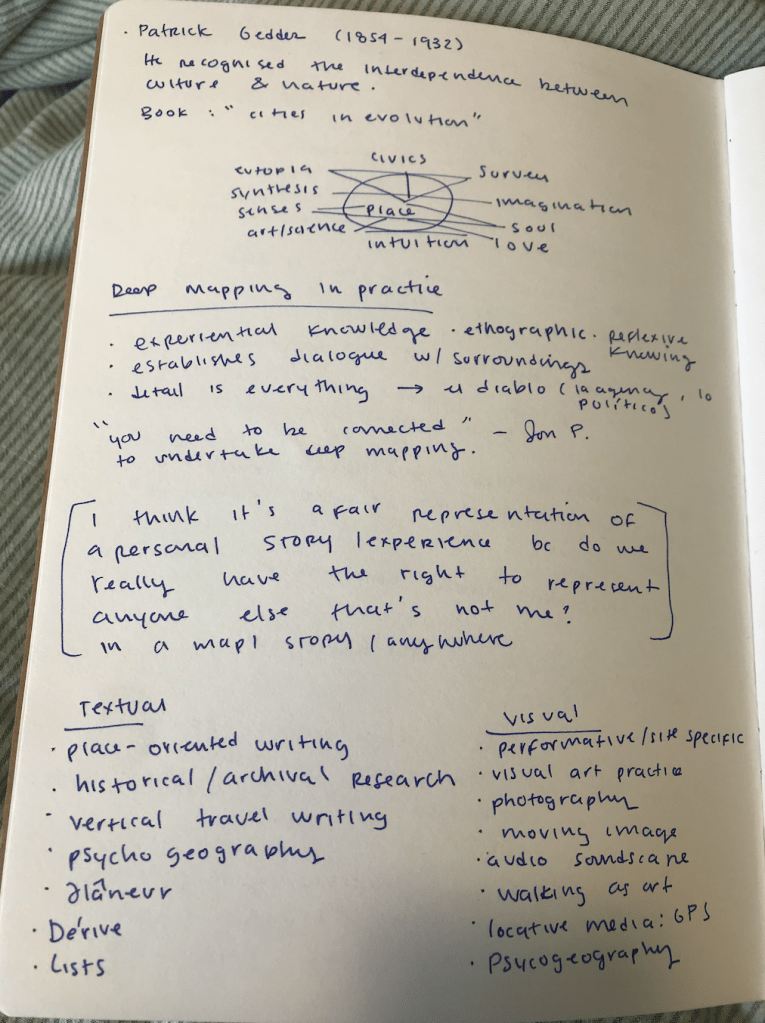
I learned about Patrick Geddes, who recognized an interdependence between culture and nature. Which made me think again about the memorial chairs and the placing of grief close to a pretty view or flowers. Deep mapping seems like a good way to communicate these layers in which we experience a place.
- A map of where chilangos are from.
- A map of how my walk on along the River Dee has changed with my getting acquainted with the city.
- A map of where grief is deposited in Aberdeen and Mexico City.
- A map of where my loved ones are.
- A map of memorial benches in Aberdeen.
- A map of how I got from Tokyo to Aberdeen.
- A map of how my movement in the city of Aberdeen has changed as I get acquainted with it.
- A map that shows where my comfort foods are from and where I find them in the city I am in.
– Seminar 8: “Curating as Process” – Judith Winter
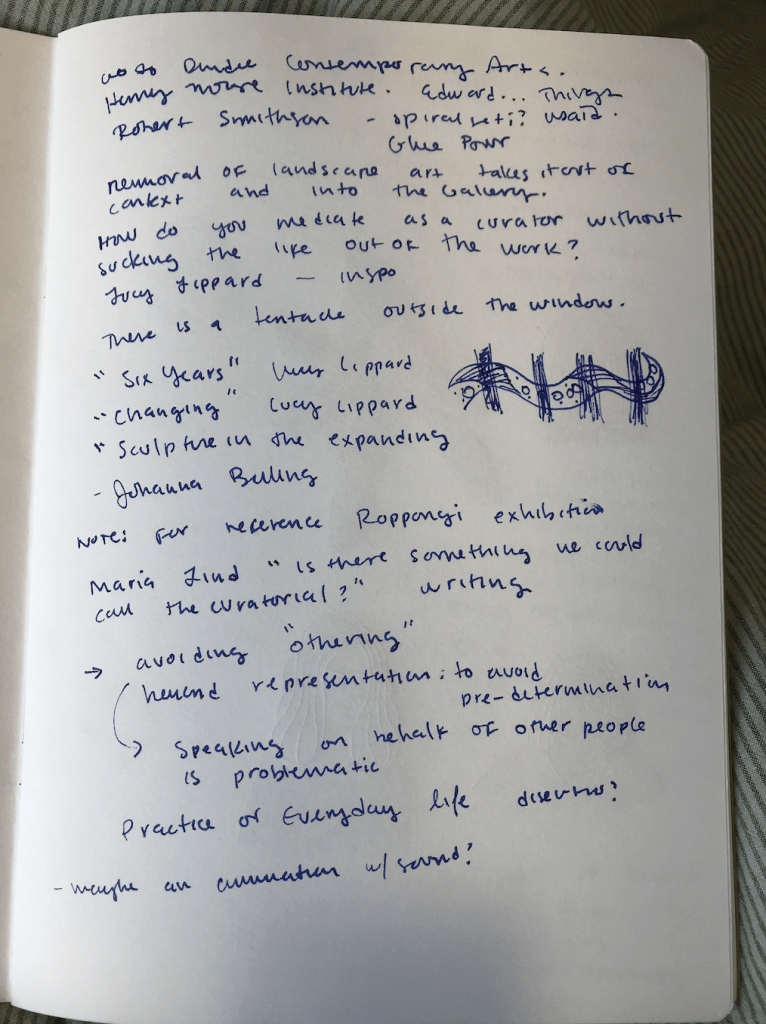
We met on the Aberdeen Art Gallery and had a conversation with curator Judith Winter. She posed the question: How do you mediate as a curator without sucking the life out of the work? She also expressed the importance of avoiding othering in the process and offered solutions to this: 1) to recognize that speaking on behalf of other people is problematic and 2) to go beyond representation to avoid pre-determination.
We had an assignment where we had to choose a piece in the Gallery to base a new exhibition on:
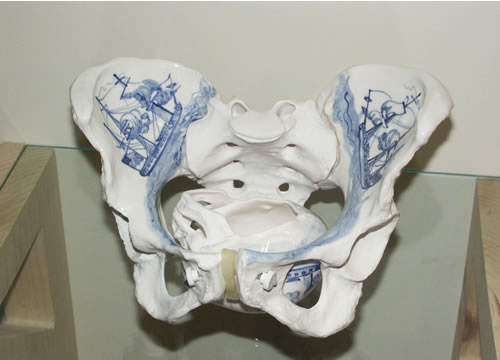
I chose “Five Set Conversation Pieces» by Christine Borland (Darvel, Ayrshire, 1965). It caught my eye the first time I went to the Gallery. It is five medical casts of infant skulls and female pelvic bones in birthing positions, painted like ornamental,18th century, Chinese ceramics pieces.
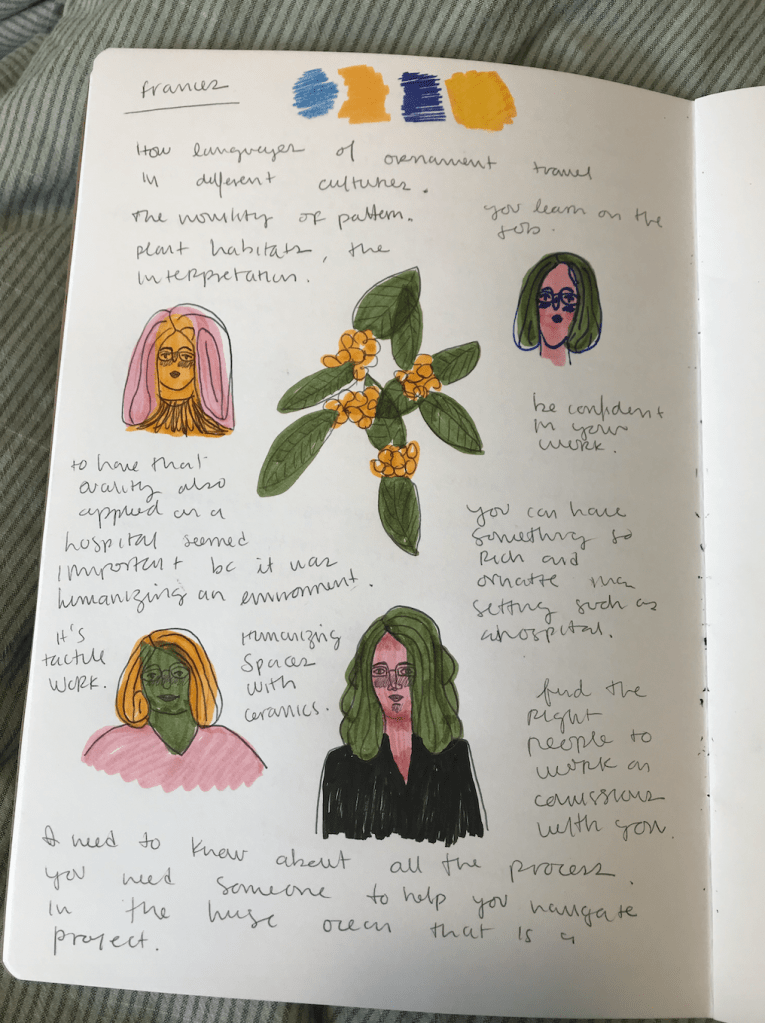
When ceramicist Frances Priest came to Gray’s, she talked about the languages of ornament and how they travel in different cultures. She said we, as humans, interpret plant habitats, for example, and from that create patterns that can move: “the mobility of pattern”, she called it. I thought it was curious how she talked about pattern like something that can perform movement, occupy spaces and humanize them.
It would be interesting to explore these languages of ornament in an exhibition based on Borland’s piece and see how humans choose particular things to apply them. How and where do we deposit the anxiety to humanize spaces or objects around the world?
– Seminar 9: “Asking Questions of Public Spaces: Unconventional Visual Narratives and Storytelling” – Charlie Hackett
This seminar made me think of looking for other ways to tell the story I want to tell, and it made me reconsider the digital. It led me to the final visual proposal for my project.
– Seminar 10: “Creative Failure” – Chris Fremantle
About creative failure:
- it’s always related to multiple sets of expectations
- it can be a success in other terms
- it is a relative concept, therefore also success
- it can be about something that we don’t know, not necessarily that it’s wrong
- it helps us understand things better, more deeply, more effectively
- the English language fails since the beginning because it only has two pronouns, it fails because of its inabilities to express complex identities (queer studies)
- a book about it: «The Guide to Getting Lost» by Rebecca Solnit
- Biesta: pedagogy talks about being in the world, not being in the center of it
- accept that everything is a process, don’t get stuck in objects
- Pete Seeger quoting some philosopher “process is actuality”
Guests at Gray’s:
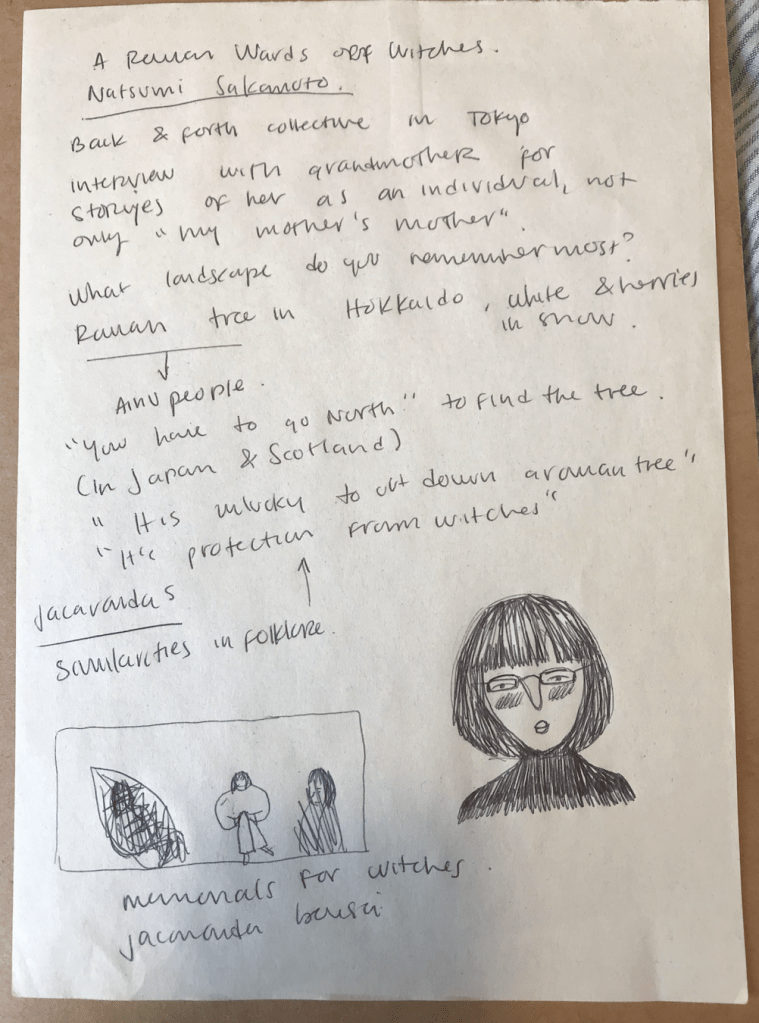
– “A Rowan Wards Off Witches” – Natsumi Sakamoto
Natsumi Sakamoto came to Gray’s to talk about her work about the rowan tree or nanakamado, in Japanese. She found similarities between Scottish and Japanese mythology surrounding the tree and found how it related to gender issues that are still relevant today in Japan.
It got me thinking about the recent murder of Ingrid Escamilla, and how a practice such as burning witches is still metaphorically and physically alive in many countries like mine. Natsumi’s video reminded me of jacaranda trees, which are so symbolic of Mexico City, but started as a gift from the Japanese in the 20’s. You can see them everywhere in the city, but mainly in Reforma Avenue, which is the place where most demonstrations take place.
She talked about how her interest had started when she asked her grandmother the question: Which landscape do you remember most? And I asked myself the same thing and, with Ingrid in mind, the landscape that came to mind was Reforma Avenue, surrounded by jacarandas and people marching to protest femicides.
I thought it was very interesting how she started her whole project from something so personal and managed to create a visual work that talks about so much more.
– Charles Esche
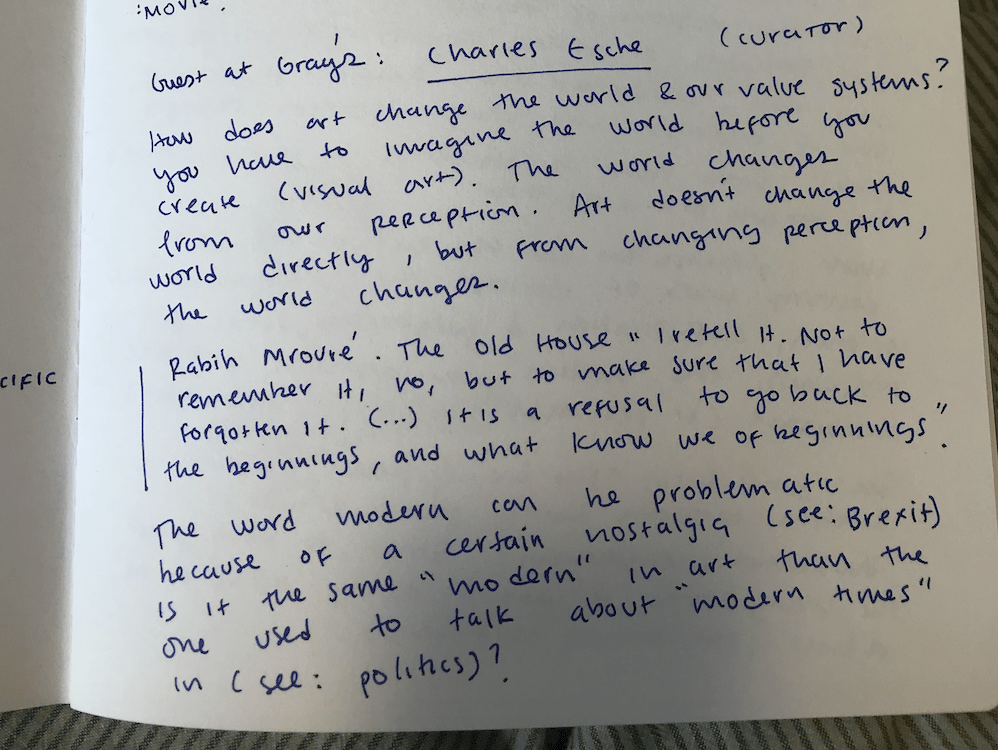
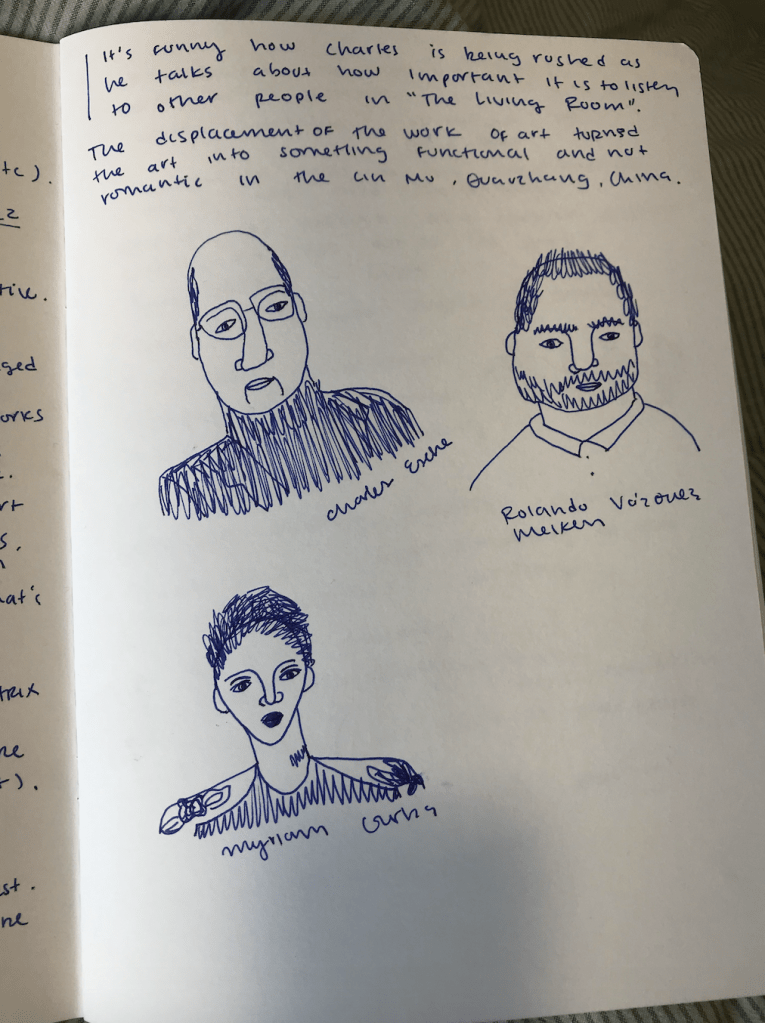
For Guest at Gray’s last week, Charles Esche spoke about how art changes the world. He said it first changes perception and then our value system and then the world. I liked that.
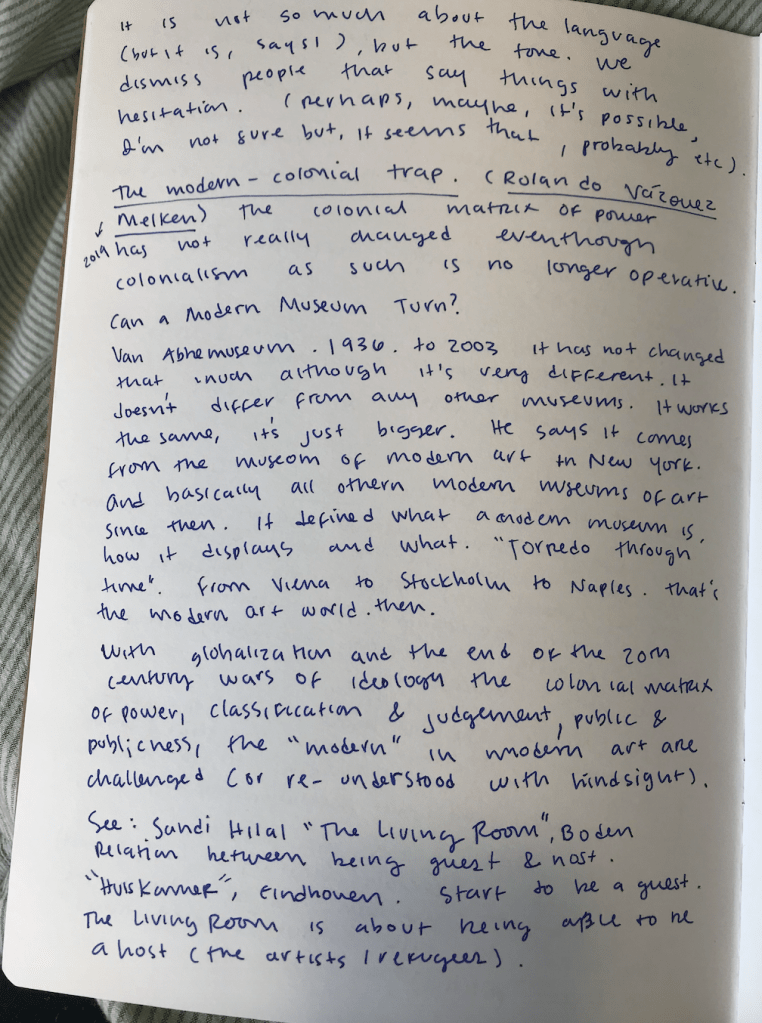
He also talked about how the word “modern” in modern art can be problematic because one might fall for the modern-colonial trap which is basically about not realizing that eurocentrism is still a thing. He referred to Rolando Vázquez Melken‘s work about the decolonizing of aesthetics:
“Eurocentrism assumes itself as universal and assumes that there is no outside its own logic, so that there is no epistemic outside and no genealogical outside its epistemic territory. When non-western-centered peoples show that they have other knowledges, other philosophies, other forms of life, they are often seen as holding romanticist positions. We are told that everyone has been touched by modernity and that there is no such thing as an ‘outside modernity’. For decolonial thought, however, there is an ‘outside’ of modernity.”
Charles also mentioned Sandi Hilal‘s “The Living Room”:
The project is inspired by a story about a Syrian refugee couple Yasmeen and Ibrahim, who had moved to Boden from Syria, and continued what was an essential part of their life back home, opening up their Madhafah-living room to host both Swedes and others in their new home in Boden.
Turning private spaces, such as the living rooms, into social and political arenas, is often a response to a limitation of political agency in the public realm.
This project highlighted the importance of being a host and being a guest and finding a balance between both in the process of inhabiting a place. I thought it was funny that Charles Esche was a guest at Gray’s himself and was being terribly rushed to finish the conversation.
– Frances Priest
Frances Priest is a ceramicist and was at Gray’s this week. She talked about how she is interested in the languages of ornament and how they travel in different cultures. She talked about “the movility of pattern” and, as an example, she mentioned how we interpret plant habitats, for example. I thought it was curious how pattern can also move, like a person. She talked about how important it is to have the quality of art and craftsmanship applied to spaces like hospitals, in order to humanize them. I didn’t have my glasses with me and couldn’t see her face clearly, so I doodled three plausible portraits of Frances Priest. I also couldn’t see the images of the presentation very well, but when she mentioned interpreting plant habitats, I made out these colors and shapes. It is my interpretation of an interpretation of a plant’s habitat.
– “The Town is the Garden” – Deveron Porjects
We went to Huntly, to the Devron Projects. The first thing I noticed was a poster that said “Plants don’t care much for borders”, and I thought it was quite beautiful and pertinent. The second thing I noticed were two books on the shelves: “Radical Gardening: Politics, Idealism & Rebellion” by George McKay and “On Guerrilla Gardening” by Richard Reynolds.
In Mexico, I had thought about how meaningful and powerful it was to grow certain things in different contexts. Growing organic corn as a form of rebellion against Monsanto, patented fields of corn, or continue to grow beans when weed is more profitable, or selling oranges and coconuts from your trees on the side of the highway without the need of a middleman.
After thinking about these acts of resistance, I thought again of green tomatoes (or tomatillos) and how my identity as a Mexican is deeply embedded in them. Tomatillos are quintessential to green salsa, green salsa to enchiladas, enchiladas to a meal, a meal to a party and a party to a home.
However, it’s always hard to get them outside of Mexico, and, most times, I can’t bring them or their seeds on an airplane. Even though plants don’t care much for borders, humans care much about their placement. This got me thinking: How can I bring tomatillos with me everywhere I go? I though about a pop-up plant of tomatillo.
At Deveron Projects, Johnathan Baxter talked about the cafeteria opening and how they want to prepare and serve food with what they produce in the orchard. These acts of growing, cooking and sharing food go back to the politics of hosting and being a guest. I thought that an illustrated recipe book could be a good way to include the community in these spaces and explore this duality.
My idea was that people could share recipes they find essential to the identity of Huntly or their own, or just delicious. I know there is a constant flow of international artists and residents, and I thought it could also be a good way to register their experiences. Maybe there is a recipe that they are missing from someplace, sometime.
I thought these collection of recipes could be illustrated and printed, maybe sold, or simply shared. My idea was that the illustrations could include facts about the person cooking, or thoughts, or feelings about the particular dish (or the person her/himself), to showcase the relationship between Huntly inhabitants and the things they grow.
 Maxim Zaragoza